Visit Tongue Fu Talking®
Does your school have a planned vocabulary spine?
A vocabulary spine is a genuinely sequenced vocabulary architecture that deliberately builds students’ capacity to think, speak and learn.
It is important because students cannot discuss ideas fluently if they do not have the language to express them; they can't add nuance to their thoughts and speak with disciplinary accuracy without the right words to do so; they cannot reason well about concepts they cannot name. Moreover, they struggle to make sense of increasingly complex curriculum content when vocabulary teaching is fragmented.
That is why, within Tongue Fu Talking®, vocabulary is not an add-on.
It sits within The Flow discipline because vocabulary shapes how students speak, explain, justify and communicate.
To make vocabulary teaching practical, we created the Five-a-Week Vocabulary Spine:
- 5 carefully selected words each week
- 36 teaching weeks
- 180 words annually
- around 1,800 explicitly taught words from EYFS to Year 9
The vocabulary is deliberately organised into five strands:
Root Words: morphology and meaning-building (Every Monday)
Academic Words: high-utility language across subjects (Every Tuesday)
Organising Concepts: the vocabulary of thinking itself (Every Wednesday)
Elaborative Words: language for nuance and precision (Every Thursday)
Human and Social Understanding: vocabulary for relationships, motivation, behaviour and emotion (Every Friday)
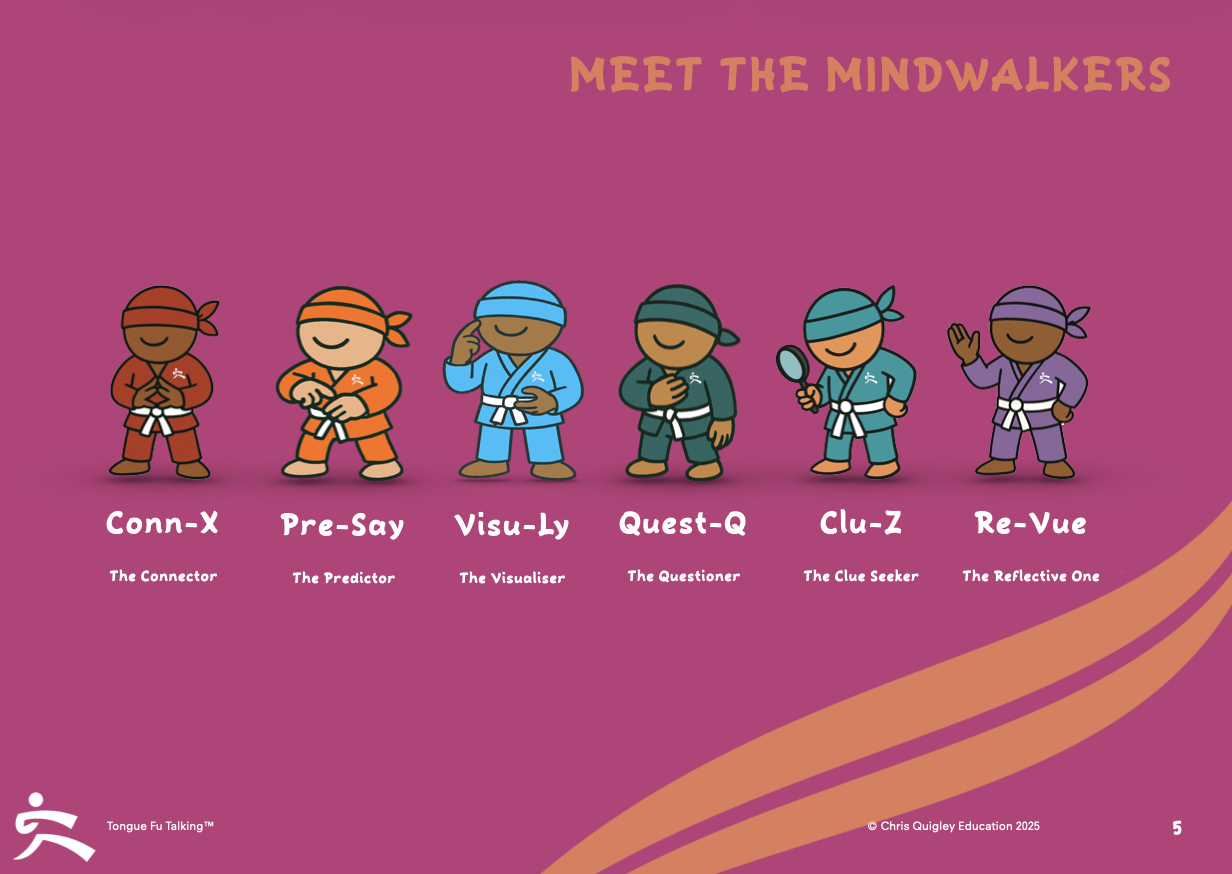
However words alone are not enough; students also need strategies for thinking with those words. In Tongue Fu Talking®, vocabulary teaching also connects directly to The Mind discipline through the metacognitive strategies of The Mindwalkers:
- Making connections
- Making predictions
- Visualising
- Asking questions
- Seeking clues
- Reflecting
This allows students to explore the words, make connections with other words they know and make reasoned reflections.
Examples
White Belt: Conn-X (The Connector)
“I think aquarium is about water because I know aqua means water.”
White Belt: Clue-Z (The Clue Seeker)
“The sentence says, ‘Be careful with the vase because it is fragile.’ That clue tells me fragile means easy to break.”
White Belt: Visual-Ly (The Visualiser)
“When I hear structure, I picture building blocks joined together.”
Green Belt: Pre-Say (The Predictor)
“Because submarine begins with sub, I predict it means something underneath.”
Green Belt: Quest-Q (The Questioner)
“Is significant just big, or does it mean important?”
Green Belt: Re-Vue (The Reflector)
“I first thought assess just meant marking, but now I think it means making a judgement using evidence.”
Brown Belt: Conn-X (The Connector)
“I can connect photosynthesis with photograph because both involve light.”
Brown Belt: Clue-Z (The Clue Seeker)
“The scientific context suggests classification has a more technical meaning than everyday grouping.”
Black Belt: Quest-Q (The Questioner)
“Am I assuming the everyday meaning of significant, when in this scientific context it may mean statistically important rather than simply noticeable?”
Black Belt: Re-Vue (The Reflector)
“My original interpretation of framework was just a physical structure, but the disciplinary context helped me understand it as an organised conceptual system.”
The impact?
Vocabulary stops being something students memorise.
It becomes something they use:
- To reason.
- To discuss.
- To explain.
- To understand.
Find out how Tongue Fu Talking® brings vocabulary, metacognition and structured oracy together.
Visit Tongue Fu Talking®


.png)